Business operating systems
Artificial intelligence applied to specific services — not a general‑purpose assistant.
Every system we build optimises one real process of the business, returns something you can see quickly, and stays under a control that casual use of AI cannot give you.
One process at a time. The first one is in use within the first week — with the count of the time it frees.
The problem we open with
Companies today have capable tools — and they use them as isolated toys.
- Information comes in through ten channels email, messages, documents, phone calls — and nobody collects it in one place. The person who has to decide walks into the meeting without the picture.
- Repetitive work stays on people’s desks. Preparing a meeting, routing a request, updating a document: hours of skilled work spent on work that does not qualify anyone.
- General-purpose tools do not know the business. They answer well in the abstract and badly in your context, because they do not have your method, your documents, your history.
- Nobody knows what an agent actually does who authorised it, what it can reach, where the data goes, who can stop it. So trust becomes a gamble, and adoption stops there.
The problem is not a lack of capability. It is a lack of structure — and of a process worth improving.
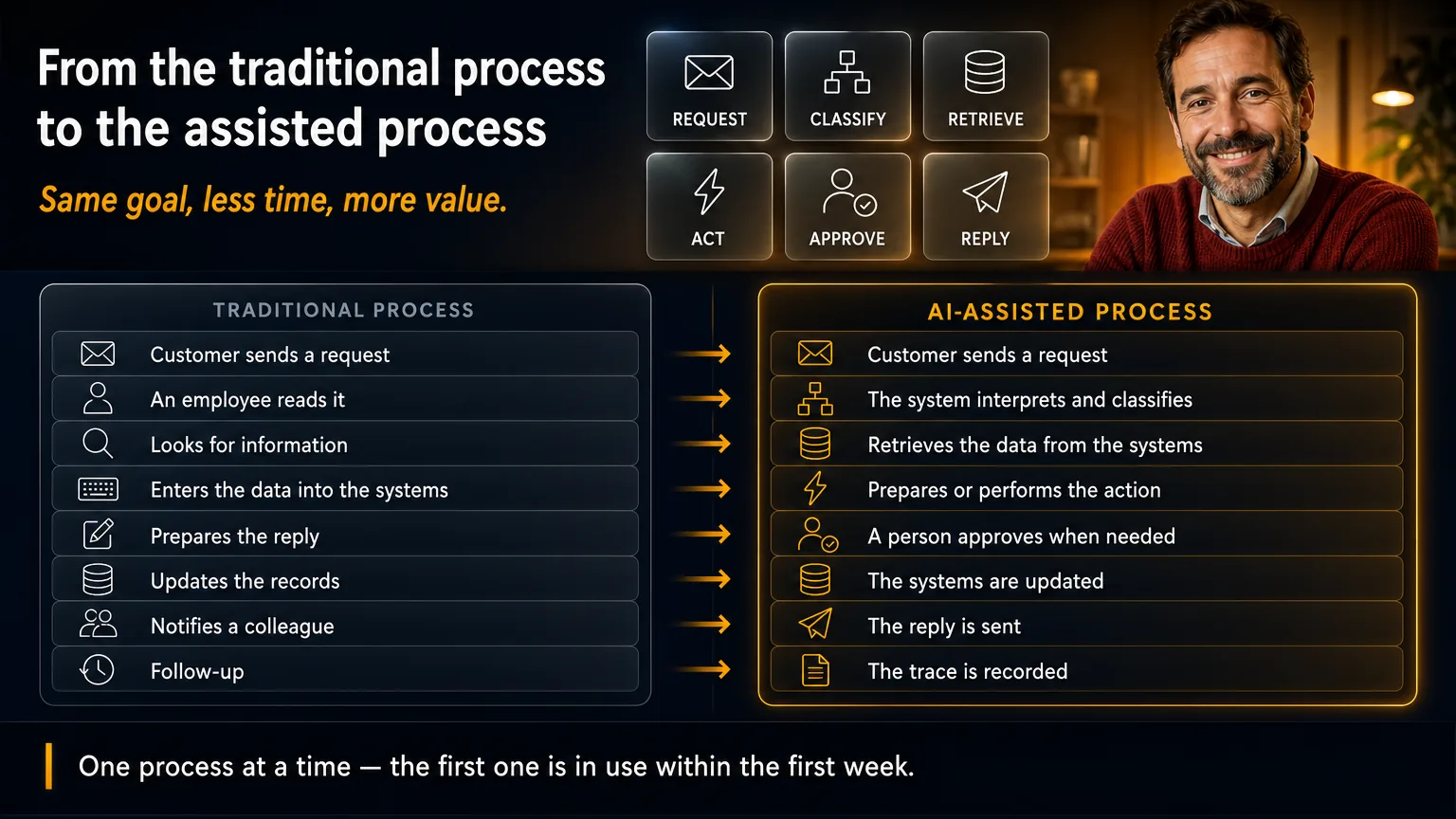
How the system works, in nine steps
Information enters the way it already enters. What changes is where it ends up — and what happens next.
- It comes in. Information arrives the way it already arrives — email, message, document, phone call. Nobody has to change how they work: what changes is where it ends up.
- It is collected. Everything that comes in lands in one place, in order, with its origin. The first gain is that the picture exists.
- It is interpreted. The system recognises what this is — who is writing, what they are asking, which process it belongs to, how urgent it is — and decides whether and where to act.
- It retrieves the company’s material. The real knowledge: documents, previous cases, the rules of your method. The intelligent system is not the archive — your data stays where it lives, and the system connects it. When the material is not enough, it says so.
- It prepares. The draft of the action — a reply, the preparation for an appointment, a document, the summary you decide on — with the sources cited.
- It decides who decides. Low risk → it acts on its own (spot checks) · medium → it proposes, an approval is required · high → a person decides, always.
- It acts and updates. The action is carried out and the systems are updated accordingly. No re-typing by hand, no step where information gets lost or changes shape.
- It leaves a trace. Every step is recorded: what arrived, what was read, what was proposed, who approved, what went out and when. The trace lives out of reach of the system that acts.
- It measures and improves. What it collected, what it handled alone, what it brought to a person, what was corrected — and a rhythm for reviewing and correcting the process.
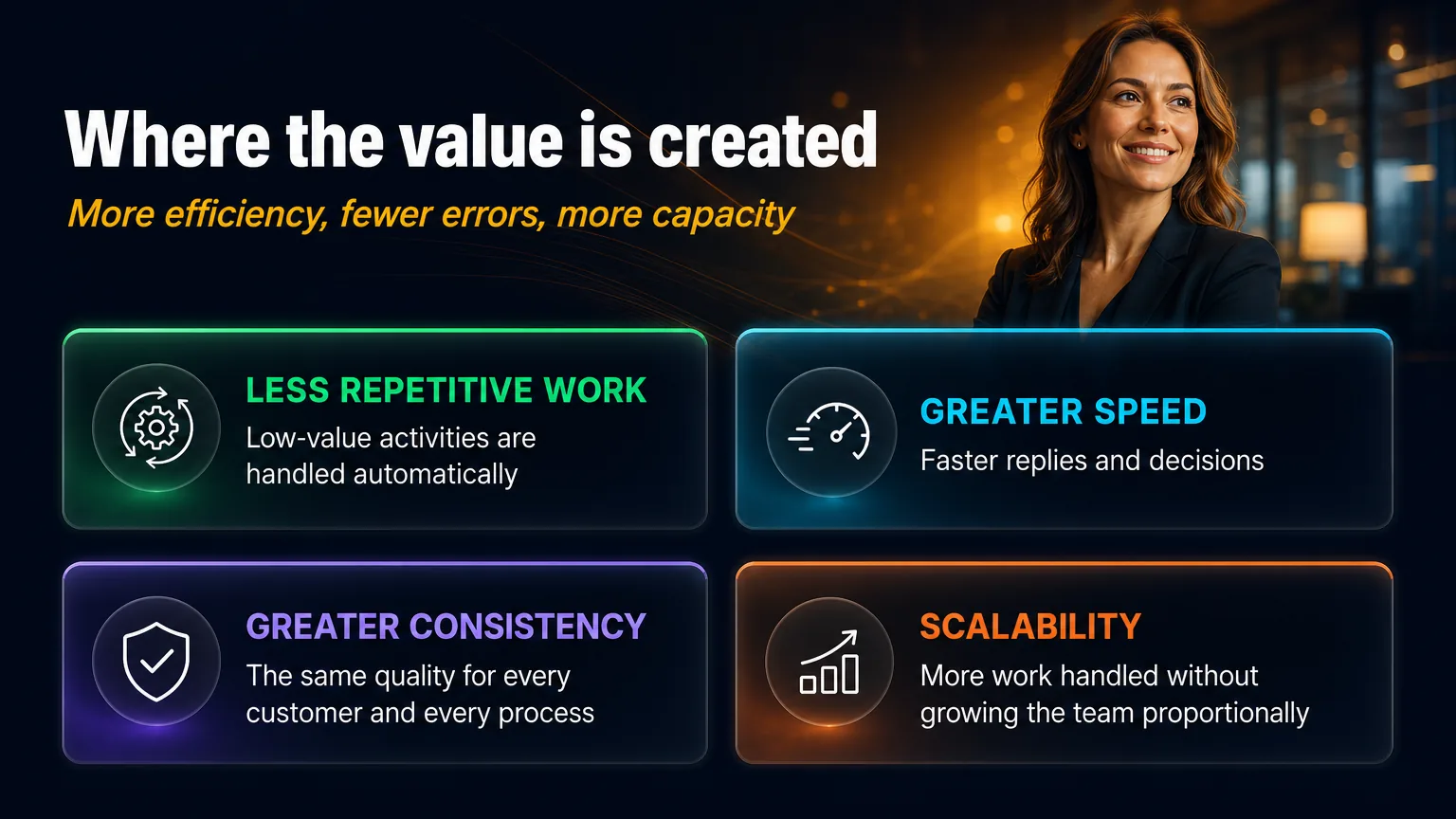
Where the value comes from
Less repetitive work · greater speed · greater consistency · capacity to grow.
And the measurement is economic, not a fashion: we count the occurrences, the time per occurrence and the hours on your process, then run the same count again once the system is in use.
Where we start
Many opportunities — start from one to three processes with the highest value. Not ten at once.

The five rules you will see in every project
- The method is yours. No system changes a process, a rule or an approved document without your go-ahead. Human validation is a blocking gate, not advice.
- We talk about capability, never about tools. In the documents you read you will not find the name of a supplier, a model or a technology: you will find what the system can do.
- Your data stays where you decide. Where the material lives is decided together, deployment by deployment, and recorded in the project.
- Nothing is deleted behind your back. The normal behaviour is to archive; deletion happens only when requested or authorised, and it leaves a trace.
- You see it before they receive it. Every message that goes outside passes through you.